Have you ever looked at the world around you, saw all the different colors, and thought to yourself, “Why do colors exist?”
In this article, I’ll be explaining the science behind colors, why we see them, why some people can’t see them or only see some, and give a few fun facts about colors.
The Science:
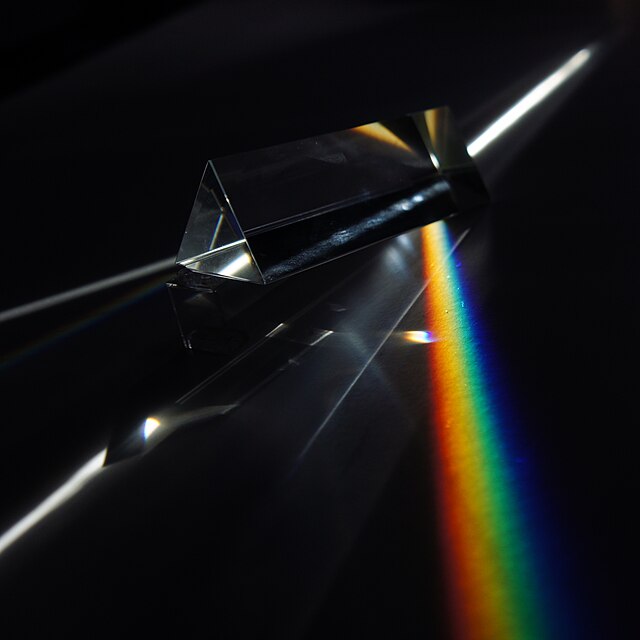
Almost all the light we see in the solar system comes from the sun. Each ray of light includes the visible light spectrum, which is the small part of the electromagnetic spectrum we can see, infrared radiation, and ultraviolet radiation. The visible light spectrum is made of seven main colors, which are red, orange, yellow, green, blue, indigo, and purple. When combined, these colors make the light appear white. Each color has a different wavelength, with red having the lowest frequency (620-750 nm) and purple having the highest frequency (380-450 nm). Since these colors have different wavelengths, when the rays reach Earth, some colors get reflected off of an object and reach our eyes, while others get absorbed into that object.
Why we see colors:
When light gets reflected off of an object and reaches your eyes, your eyes and brain work together to help you see what color the object is. Our eyes have photoreceptors called cones and rods inside of them. Cones handle bright light and are sensitive to red, green, and blue. Rods handle dim light, but only in shades of gray, which helps us see in dark places. These cones send signals through the optic nerve to the visual cortex, which processes visual information. The brain then processes what the cones sent them to let us see the object in a specific hue.
Color Blindness:
Color blindness is a condition where some people either can’t see certain colors very well, can’t see certain colors at all, or can’t see any colors. Color blindness affects 1 in 12 men and 1 in 200 women. This is because men only have one X chromosome (XY), and women have two X chromosomes (XX). So, if a man’s X chromosome gets a defective gene, they’ll be color blind. But for a woman, two X chromosomes would need to have a defective gene.
The most common type of color blindness is red-green color blindness, which is either Deuteranopia/Deuteranomaly (green deficiency) or Protanopia/Protanomaly (red deficiency). About 95-99% of people with color blindness have red-green color blindness. Tritanopia/Tritanomaly (blue-yellow deficiency) is quite rare, with only 5% or less of color blind people having a blue-yellow deficiency. Achromatopsia (total color blindness) is the rarest of them all, only affecting about 1 in 33,000 people in this world.
If you meet someone who is color blind, do not immediately point at something and ask, “What color is this?” This can be very annoying to them and can make that person feel like a test subject. Some examples of better questions to ask them include questions like, “How does color blindness affect your daily life?” or “What colors do you struggle with the most?” Making the person feel human and understood.
Some ways to accommodate people with color blindness include using labels and words in things like graphs, charts, etc. and not fully relying on color. Using tools like color-blindness.com to make sure your designs are accessible to people who are colorblind can help them a lot. Labeling which color colored pencils, crayons, etc. are can also help.
Fun Facts:
- Each human eye has around 110 million rods on average, but only around 6 million cones on average.
- Colors do not exist in the physical world, they only exist in the individual’s brain.
- Vantablack is the darkest color in the world and absorbs around 99.965% of the light that reaches it.
- Bees cannot see the color red, but they can see ultraviolet light.
- Yellow is the first color people see. It’s also the most visible color in the spectrum.
- Pink isn’t part of the visible light spectrum because it’s a mix of red and blue or violet wavelengths. Since these wavelengths don’t naturally meet, our brains imagine pink to fill in that gap.
- While most people who are color blind have it from birth, someone can also get color blindness from aging, diabetes, certain medications, etc.
- Sir Isaac Newton invented the color wheel in 1666 by splitting white light into the different colors of the visible light spectrum using a prism.
- White is the most popular color for vehicles because it’s the safest color on the road due to it being very visible.
- Red is known to increase heart rate and appetite, while blue is known to decrease heart rate and appetite.