
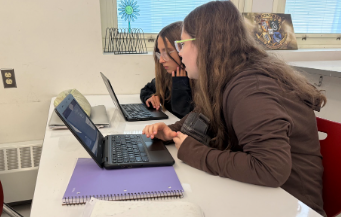
Artificial Intelligence is here, and it’s not going anywhere. From medical research and procedures to agriculture and manufacturing. One main recent development of AI in our everyday lives is the NEO Robot. The NEO Robot is a home robot primarily powered by AI and costs $20,000. The bot can do home tasks like dishes, laundry, watering plants, and other everyday human chores. AI is now woven into the fabric of our lives, and we can no longer untangle it. The question is… how do we help students to prepare for the future?
What is Artificial Intelligence?
Artificial intelligence (AI) is technology that enables computers and machines to simulate human learning, comprehension, problem solving, decision making, creativity and autonomy. People commonly mistake AI as just coming in the forms of apps or websites like ChatGPT, but in reality, it’s also being used in hospitals, large administrations, and many other intricate work fields. So as you can see, it’s used almost everywhere in the modern world.
Benefits:
There are plenty of benefits of artificial intelligence, including in schools. Some of those benefits include personalized learning for students who may struggle with specific topics, pre-programmed administrative tasks that make work easily completable for teachers and admin, and enhanced accessibility for students who may need extra help due to disabilities.
Some parents feel as though AI can be positive if used correctly. For example, my mother, Tara Fallon, believes that if used right, artificial intelligence can benefit both teachers and students. She shared, “I think AI benefits the learning experience for my child if they are using it for supplemental instruction on a topic.”
When asked about whether or not teachers should use it in their lessons or to create assignments, she said, “Why shouldn’t they? They’re looking it up and doing research anyway. It will lead to fresh perspectives, as long as it’s reliable information. Plus, maybe AI-generated lessons could better reach more students that may be struggling in school.” However, Fallon brings up an important caveat: “At the end of the day, it all comes down to integrity.”
Mr. Olvesen is a science, STEM, and robotics teacher at WMS. He specifically speaks about artificial intelligence in his class and takes his students’ opinions on it into account during his robotics classes. He said, “Technology is always allowing us to innovate, and this is just the latest innovation. People probably questioned if the internet was a good thing or not when it first started, and now look at how far that has come.” He also mentioned that he uses AI quite a lot in his personal and professional life. Still, he warns that people have to double-check some things due to AI being inaccurate sometimes or using unreliable sources.
Concerns:
Although artificial intelligence may have many benefits in schools, some concerns need to be taken into account, like cheating and plagiarism.
Alyssa Alvarado- Alyssa is a straight-A student at WMS as well as president of the National Junior Honor Society, and she is in the eighth grade. She said that she likes to use AI to explain different topics, but doesn’t cheat off of it. She said, “I don’t love AI, especially in classrooms, because it can sometimes produce false information.” Sometimes she uses artificial intelligence to help with her homework, but she only uses explanations and not answers.
Olivia Cavaliere- Olivia is a Woodbridge Township graduate, who is now 22 years old, and expressed that when she attended middle and high school artificial intelligence was not mainstream like it is now, “I wish that artificial intelligence was around when I was in school, I would have done all of my assignments with it, the same way we had the app Photomath, I would’ve had A’s in all of my classes,” Olivia said. When asked if she uses AI now she said, “All of the time, whenever I have a question about absolutely anything. It’s like the new Google.” Olivia’s honesty highlights a major concern about AI because it shows that AI is slowly taking away our critical thinking and problem-solving skills.
Taylor West- Taylor West is an outgoing eighth-grade student at WMS who says that he enjoys using artificial intelligence when it comes to school work. He stated, “I wouldn’t mind being assigned an assignment that my teacher generated using AI., I would just use AI to complete it as well.” He also added, “I personally use AI to help with homework, and I use the app Guath, and it helps me with my homework. When I use it, I just write the answers down; I don’t really look at the explanations.” Taylor’s responses draw many red flags in my opinion. By relying on AI and technology for answers, students don’t learn anything, which would ultimately lead them to difficulties during testing.
Personal Experience:
I am an honor roll eighth-grade student at WMS. I feel that AI is a tool that could be beneficial to the learning environment in specific ways, but if it is not taught to be used correctly, it can be harmful to the learning process. Students are going to use it to cheat, obviously, which isn’t good, and I can’t say that I haven’t either at some point in time. Despite that, I like AI because if I don’t understand a topic, specifically math, it is really good at explaining and breaking it down.
Although I find it to be a good tool, I also have my concerns. I’m not sure if every student feels this way, but I’ve found that if you use it for even one assignment, it can become addictive, which could be dangerous in some cases. As far as teacher use goes, I think it is a good supplement for them, and I have no fears about AI replacing them one day, because humans have something that AI cannot replace, which is human connection.
Is AI inevitable?
Artificial Intelligence is quickly becoming a tool we use every day. As this happens, the key thing to remember is that we must use it correctly and be prepared for the future.
Mr. Malmstrom is a journalism and language arts teacher at WMS, who is also the head of the language arts department here. His opinion on AI varies, as he sees pros and cons.
When asked if he believes artificial intelligence being incorporated into the learning environment is a good thing, he said, “I am not a fan of the way that it is being done, because right now it’s almost like education is pushing against something that is going to happen inevitably. All of the software that the teachers use is to keep students from not using AI, but then teachers have software that helps them to create assignments and things like that.”
In addition, he said, “I think that we are trying to prevent students from using it to cheat, but there needs to be a different approach on AI in our schools because it’s going to be in our schools eventually and we can’t prevent that. Instead I think we need to teach students how to use it properly and also have situations where they learn how not to use it.”
I agree with a lot of what Malmstrom said, especially that schools need to take a better approach on AI. I have always believed in the saying, “strict parents raise sneaky kids,” and I think the same thing goes for teachers. Merely saying, “Don’t use AI,” only makes students want to use it more. Instead, schools need to teach students how cheating will affect them down the line.
Interviewing AI Itself
As any good journalist would, I decided to go directly to the primary source for an interview–ChatGPT.
Just like humans, AI also has an opinion on itself. When ChatGPT was asked if it thinks it is a good thing for AI to be used in classrooms, it responded by stating benefits and potential drawbacks, “Potential Benefits include personalized learning, teacher support, accessibility, and engagement. Potential drawbacks include over-reliance on technology, bias and fairness, privacy concerns, and teacher replacement fears.”
In summary, it said, “Artificial Intelligence can be a powerful supplement to education–but it should be used with guidance, transparency, and a focus on human-centered learning.”
Conclusion:
Overall, there are plenty of benefits and concerns when it comes to artificial intelligence being incorporated into classrooms. The majority of people interviewed believe that AI is beneficial if used responsibly, while others shared that they would just use it to cheat if it were to be further implemented into classrooms. I think that the future of AI is bright, but I didn’t always think that way.
Before doing my research, I had an aversion to AI and didn’t think it was a good thing. After writing this, my perspective has completely changed, and I hope that after you have read this, yours has shifted as well, or at least made you think about the topic more.














Amelia Carrero • Feb 17, 2026 at 9:19 am
Very well written!
Taylor west • Nov 20, 2025 at 11:39 am
im tuffffff
Kathleen Depow • Nov 19, 2025 at 9:51 pm
A very thought provoking article which was reported in a fair and balanced manner. The author provided both the pros and cons of AI use in schools, allowing us to come to our own conclusion. The idea of interviewing the creation itself was brilliant!