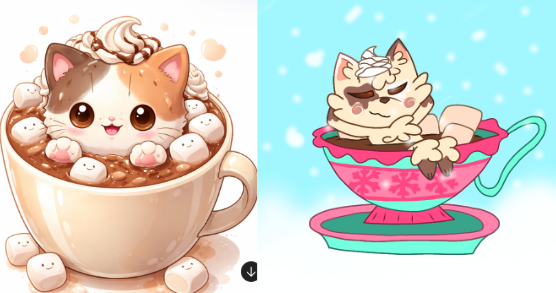
Artificial Intelligence (AI) is a game changer in today’s society. We all can’t deny it’s helped us in many ways. However, AI is starting to negatively impact specialized areas of our lives. Art is one of the main areas this focuses on. For those unaware, AI generated art is art or images fabricated by using an AI (shocker). It’s typically created once someone types in a prompt on a software like Chat GPT. Artists are infuriated with AI art, claiming that it isn’t real art and doesn’t deserve any recognition, while others don’t mind or even find delight in it. My stance is that AI doesn’t have a place in art. Instead of simply listing endless and ambiguous reasons, I’ll be debunking the points defenders of AI generated art often make.
Efficiency
A common “benefit” people praise AI art for is how quickly it can generate. For example, Mr. Olvesen, a science, STEM, and robotics teacher at WMS uses AI when making announcement posters for the school. He stated, “It was done in 30 seconds.” AI in this case isn’t that detrimental, since it’s to accomplish a small term goal. Plus, it’s not like Mr. Olvesen was going to publish it on the internet.
However, learning art as a hobby takes time like any other activity. If anything, art being time consuming is a benefit, since the more time you put into it, the more you improve and once you start noticing improvement, you feel a sense of triumph! Rome wasn’t built in a day. You didn’t start walking in a day. Things take an abundance of time to accomplish.
What about companies that have started using AI images or videos? In today’s day and age there’s many businesses that use AI to help them advertise. One of the most infamous examples is Coca Cola’s holiday commercial made in 2024. All the visuals were created using Real Magic AI.
Some people defend this as a company trying to be efficient, but I see this as laziness.
The commercial is littered with weird cuts and continuity errors, like when the scene switched angles on the bunnies or when three seals became four out of nowhere. There’s also elements like pandas and sloths that don’t make sense considering it’s a winter commercial. This looks like just a quick way to pump out a holiday ad and save them money and it worked!
The commercial cost about 4-5 million dollars to make, a ginormous cut from the billions they spend on human-made ads. Still, I feel companies would be way better off with just spending the money on something that looks cleaner and well done, then something half baked and smothered in mistakes only an AI can make.
Generate ideas
AI artists point out the endless ideas they can get from AI. This is one of the few points I can partially agree with. Mrs. Donewitz, WMS’s art teacher agrees, stating, “I feel AI generated ideas are appropriate for brainstorming ideas.” I even go on Pinterest, an app that uses AI to modify and recommend images. I was interviewing Chat GPT about this topic and it added, “It lets beginners quickly visualize ideas, experiment with different styles, and explore creative concepts they might not yet have the technical skills to draw or paint themselves.”
However, Mrs. Donewitz added that AI “should not be used to replace human creativity” and I agree. I also agree that we shouldn’t ignore the inspiration around us, like nature, music, books, and the people in our lives. Getting ideas from an AI isn’t inherently terrible, but more meaningful art comes from ideas and inspiration from an artist’s real life.
Accessibility to New Artists
AI can be quite dangerous for new artists if not controlled. For one, if a beginner solely uses AI to generate their “own” art, then they’ll be missing out on learning central fundamentals like anatomy and color theory, things that artists need. If you ask me, it just removes the process of practice, learning, creating independently, and just touching some graphite. I don’t really understand why someone would do that either, as AI is there as a tool which is supposed to make things easier, not remove the process altogether.
Solely using AI can also prevent a beginner’s ability to create something original. Hila Neiditch, a student and fellow artist at WMS expressed her concerns. She explained how beginner artists who primarily depend on AI miss out on “making their own things, creating their own characters without getting something else to make it for you [them].” She also talked about how those artists will miss out on making original stories that mean something to them.
Anyone can take a picture and not be a photographer, anyone can cook but not be a chef, and anyone can have an idea but not be an artist. What makes all these professions happen is hard work and months, if not years of practice.
Self-Expression
Part of the reason art even exists is to let anyone freely express themselves in society. “Art provides students with an outlet for self expression and a way to find enjoyment and relaxation,” stated Mrs. Donewitz after being asked what the importance of art is. She also explained that AI can be a quick way to let out frustration or sadness through a generated image. However, when being asked if artists can achieve self expression, Mrs. Donewitz wholeheartedly agreed. But she explained how she felt that “more traditional art that is created through the lived experience of actually drawing or painting can capture more of the human quality of self expression.”
I have to go with Mrs. Donewitz here. I feel like art is way more meaningful if it were made by an actual person and their emotions. That way, the artist can feel somewhat satisfied and connected to his or her creation. It’s kind of where the SELF part comes in. Human created self expression can also help audiences connect and relate to the piece as well as admire the artist’s intent and dedication.
History Repeats Itself
It’s a no-brainer that sooner or later AI is going to start taking over jobs and artists are in big danger. Defenders of AI try to shut down this argument, saying it’s like when printing presses and the internet were invented and they’d be right. Technology has taken the jobs of many throughout history, such as press operators, clerks, factory workers, and so much more. However, this is not really about jobs, but about slowly losing what makes us human. We’ve had art since the beginning of time. Like stated previously, art offers individuals a way to express themselves, problems in society, and just have fun in general. If society keeps pushing art into the hands of AI, it will eventually become lost to future generations.
Another point people use to defend AI art is comparing it to how photography was first received during the 1820s. Photography was deemed “too easy” and that “anyone can be a photographer, therefore it couldn’t be an art.” They then compared that to how AI art is being criticized. This comparison is unfair. Yes, photography is not the same as traditional art and should be put in a different genre of art. However, unlike generating AI images, a human being has to physically find a setting, manipulate the objects around the subject, adjust the camera angles, lighting, and know essential skills in order to perfect the skill. As a photo journalist at WMS, I can clarify how tough it could be to get good photos and how rewarding it feels to take a perfect one. I’m sorry, but making an AI generated image does not replicate that feeling for me.
Now that I’ve debunked pretty much all the points people use to defend AI, I want to dedicate a portion of this article to talk about a very serious concern with creating AI generated images.
Copyright infringements/permission
AI software generates images by taking bits of preexisting images and mushing them all into one. Software needs to be fed more and more art in order to be perfected. Most of the time when people give art to these software, they don’t get the permission from the original artist. They also might do it against the artist’s wishes.
For example, there was a recent situation involving Buzzfeed, a media production company and one of their shows Chikin Nugget. Buzzfeed was using Chikin Nugget to train AI models against the creator’s wishes. The creator then went on strike and hundreds of fans were outraged. Honestly, who wouldn’t be? Imagine someone basically stole your art and used it for causes you’re strongly against. That example is of someone who KNEW what their work was being used for. Imagine all the artists who are unaware that their hard work is being used to train an AI. Using someone’s work without permission and/or against their wishes is the textbook definition of plagiarism. Hila Neiditch agrees with me, believing AI generated images should not be acceptable if someone claims it as their own. This, alongside job loss can seriously harm the art world and the rights of artists.
Solutions
Thankfully, solutions are already being implemented for this crisis. Buzzfeed stopped using Chikin Nugget to train AI models after all the criticism. A new law was also established in the United States Copyright Office (USCO), stating that human made adjustments must be made to AI generated products in order to be patented/copyrighted. It finally looks like society is placing boundaries on AI in the arts and I am here for it!
In order to gain a deeper understanding of the issue, I went directly to the source, so I interviewed Chat GPT about future solutions for AI in the art world and I was surprised to see that it provided very human responses. One of my favorites being, “If artists’ work is used to train AI models, laws could require companies to pay licensing fees or royalties,” and, “Laws might address whether companies can market tools that replicate a recognizable artist’s style without permission.” This fixes both the consent and plagiarism issue. Mr. Olvesen said he believes that as humans, “we can adapt to the new changes going on in our world,” meaning we’ll have to find a way to let technology thrive while letting artists have their own safe space.
We should encourage beginner artists to use AI in very small capacities. Use it for brainstorming and explaining fundamentals. However, I would encourage beginners to look at real people’s art, as well as the world around them in order to find an art style and get good ideas.
Conclusion
AI needs to be minimized in order to protect artists’ rights, avoid plagiarism, and encourage originality and learning in beginners. It’s important that we adapt to the new changes and set societal norms for AI in art so that the human experiment that is art doesn’t become extinct. It’s really nice to see laws being passed to protect the art world and encourage more people to be creative. I can’t wait for the future of art and to see brand new beginner artists thrive.